Our body is a whole human structure that consists of different parts with their different functions that plays a very important role in our everyday lives. As we go on, you'll see this blog containing facts about the major system in our body.
Introduction of Endocrinology
Endocrine system is made up of series of glands which produces different substances also known as Hormones which has different jobs to do in our body.

Photo Credit: http://trialx.com/curetalk/wp-content/blogs.dir/7/files/2011/05/diseases/Endocrine_System_Diseases-3.jpg
Endocrine System: How it Works
Video Credit: http://www.youtube.com/watch?v=YI2qYRWzSZ4
Endocrine System and the Hormone secreted
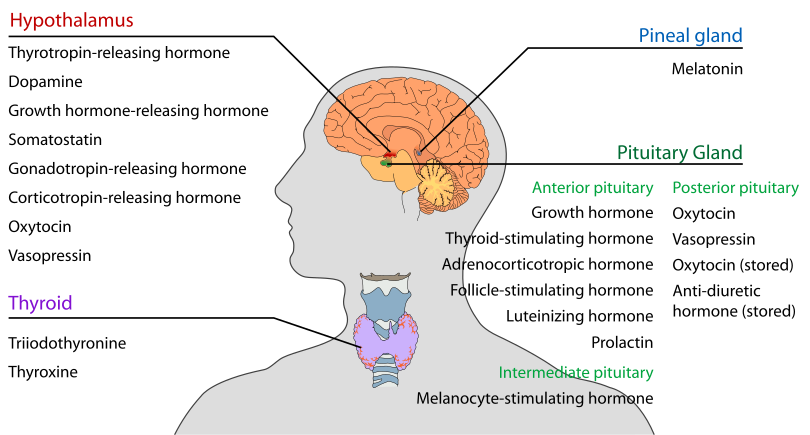
Hypothalamus
Pineal body (epiphysis)
| Secreted hormone | From cells | Effect |
|---|---|---|
| Melatonin | Pinealocytes | Antioxidant Monitors the circadian rhythm including inducement of drowsiness and lowering of the middle body temperature sleep cycle |
Pituitary gland (hypophysis)
Anterior pituitary lobe (adenohypophysis)
| Secreted hormone | Abbreviation | From cells | Effect |
|---|---|---|---|
| Growth hormone (somatotropin) | GH | Somatotrophs | Stimulates growth and cell reproduction Stimulates Insulin-like growth factor 1 release from liver |
| Thyroid-stimulating hormone (thyrotropin) | TSH | Thyrotrophs | Stimulates thyroxine (T4) and triiodothyronine (T3) synthesis and release from thyroid gland Stimulates iodine absorption by thyroid gland |
| Adrenocorticotropic hormone (corticotropin) | ACTH | Corticotrophs | Stimulates corticosteroid (glucocorticoid and mineralcorticoid) and androgen synthesis and release from adrenocortical cells |
| Beta-endorphin | - | Corticotrophs | Inhibits perception of pain |
| Follicle-stimulating hormone | FSH | Gonadotrophs | In females: Stimulates maturation of ovarian follicles in ovary In males: Stimulates maturation of seminiferous tubules In males: Stimulates spermatogenesis In males: Stimulates production of androgen-binding protein from Sertoli cells of the testes |
| Luteinizing hormone | LH | Gonadotrophs | In females: Stimulates ovulation In females: Stimulates formation of corpus luteum In males: Stimulates testosterone synthesis from Leydig cells (interstitial cells) |
| Prolactin | PRL | Lactotrophs | Stimulates milk synthesis and release from mammary glands Mediates sexual gratification |
| Melanocyte-stimulating hormone | MSH | Melanotropes in the Pars intermedia of the Anterior Pituitary | Stimulates melanin synthesis and release from skin/hair melanocytes |
Posterior pituitary lobe (neurohypophysis)
| Secreted hormone | Abbreviation | From cells | Effect |
|---|---|---|---|
| Oxytocin | Magnocellular neurosecretory cells | Uterine contraction Lactation (letdown reflex) | |
| Vasopressin (antidiuretic hormone) | ADH or AVP | Parvocellular neurosecretory neurons | Increases water permeability in the distal convoluted tubule and collecting duct of nephrons, thus promoting water reabsorption and increasing blood volume |
Oxytocin and anti-diuretic hormone are not secreted in the posterior lobe, merely stored.
Thyroid
| Secreted hormone | Abbreviation | From cells | Effect |
|---|---|---|---|
| Triiodothyronine | T3 | Thyroid epithelial cell | (More potent form of thyroid hormone) Stimulates body oxygen and energy consumption, thereby increasing the basal metabolic rate Stimulates RNA polymerase I and II, thereby promoting protein synthesis |
| Thyroxine (tetraiodothyronine) | T4 | Thyroid epithelial cells | (Less active form of thyroid hormone) (Acts as a prohormone to triiodothyronine) Stimulates body oxygen and energy consumption, thereby increasing the basal metabolic rate Stimulates RNA polymerase I and II, thereby promoting protein synthesis |
| Calcitonin | Parafollicular cells | Stimulates osteoblasts and thus bone construction Inhibits Ca2+ release from bone, thereby reducing blood Ca2+ |
Alimentary system

Stomach
| Secreted hormone | Abbreviation | From cells | Effect |
|---|---|---|---|
| Gastrin (Primarily) | G cells | Secretion of gastric acid by parietal cells | |
| Ghrelin | P/D1 cells | Stimulate appetite,
secretion of growth hormone from anterior pituitary gland
| |
| Neuropeptide Y | NPY | increased food intake and decreased physical activity. It can be associated with obesity. | |
| Somatostatin | D cells | Suppress release of gastrin, cholecystokinin (CCK), secretin, motilin, vasoactive intestinal peptide (VIP),gastric inhibitory polypeptide (GIP), enteroglucagon
Lowers rate of gastric emptying Reduces smooth muscle contractions and blood flow within the intestine.
| |
| Histamine | ECL cells | stimulate gastric acid secretion | |
| Endothelin | X cells | Smooth muscle contraction of stomach |
Duodenum
| Secreted hormone | From cells | Effect |
|---|---|---|
| Secretin | S cells | Secretion of bicarbonate from liver, pancreas and duodenal Brunner's glands
Enhances effects of cholecystokinin Stops production of gastric juice
|
| Cholecystokinin | I cells | Release of digestive enzymes from pancreas |
Liver
| Secreted hormone | Abbreviation | From cells | Effect |
|---|---|---|---|
| Insulin-like growth factor (or somatomedin) (Primarily) | IGF | Hepatocytes | insulin-like effects
regulate cell growth and development
|
| Angiotensinogen and angiotensin | Hepatocytes | vasoconstriction | |
| Thrombopoietin | Hepatocytes | stimulates megakaryocytes to produce platelets |
Pancreas
| Secreted hormone | From cells | Effect |
|---|---|---|
| Insulin (Primarily) | β Islet cells | Intake of glucose, glycogenesis and glycolysis in liver and muscle from blood |
| Glucagon (Also Primarily) | α Islet cells | glycogenolysis and gluconeogenesis in liver
increases blood glucose level
|
| Somatostatin | δ Islet cells | Inhibit release of insulin |
| Pancreatic polypeptide | PP cells | Self regulate the pancreas secretion activities and effect the hepatic glycogen levels. |
Kidney
| Secreted hormone | From cells | Effect |
|---|---|---|
| Renin (Primarily) | Juxtaglomerular cells | Activates the renin-angiotensin system by producing angiotensin I of angiotensinogen |
| Erythropoietin (EPO) | Extraglomerular mesangial cells | Stimulate erythrocyte production |
| Calcitriol (1,25-dihydroxyvitamin D3) | Active form of vitamin D3
Increase absorption of calcium and phosphate from gastrointestinal tract and kidneys inhibit release ofPTH
| |
| Thrombopoietin | stimulates megakaryocytes to produce platelets |
Adrenal glands
Adrenal cortex
| Secreted hormone | From cells | Effect |
|---|---|---|
| Glucocorticoids (chiefly cortisol) | zona fasciculata and zona reticularis cells | Stimulates gluconeogenesis Stimulates fat breakdown in adipose tissue Inhibits protein synthesis Inhibits glucose uptake in muscle and adipose tissue Inhibits immunological responses (immunosuppressive) Inhibits inflammatory responses (anti-inflammatory) |
| Mineralocorticoids (chiefly aldosterone) | Zona glomerulosa cells | Stimulates active sodium reabsorption in kidneys Stimulates passive water reabsorption in kidneys, thus increasing blood volume and blood pressure Stimulates potassium and H+ secretion into nephron of kidney and subsequent excretion |
| Androgens (including DHEA and testosterone) | Zona fasciculata and Zona reticularis cells | In males: Relatively small effect compared to androgens from testes In females: masculinizing effects |
Adrenal medulla
| Secreted hormone | From cells | Effect |
|---|---|---|
| Adrenaline (epinephrine) (Primarily) | Chromaffin cells | Fight-or-flight response:
|
| Noradrenaline (norepinephrine) | Chromaffin cells | Fight-or-flight response:
|
| Dopamine | Chromaffin cells | Increase heart rate and blood pressure |
| Enkephalin | Chromaffin cells | Regulate pain |
Reproductive

Photo Credit: http://upload.wikimedia.org/wikipedia/commons/c/c2/Endocrine_reproductive_system_en.svg
Testes
| Secreted hormone | From cells | Effect |
|---|---|---|
| Androgens (chiefly testosterone) | Leydig cells | Anabolic: growth of muscle mass and strength, increased bone density, growth and strength,
Virilizing: maturation of sex organs, formation of scrotum, deepening of voice, growth of beard andaxillary hair.
|
| Estradiol | Sertoli cells | Prevent apoptosis of germ cells |
| Inhibin | Sertoli cells | Inhibit production of FSH |
Ovarian follicle and corpus luteum
| Secreted hormone | From cells | Effect |
|---|---|---|
| Progesterone | Granulosa cells, theca cells | Support pregnancy:
Other:
|
| Androstenedione | Theca cells | Substrate for estrogen |
| Estrogens (mainly estradiol) | Granulosa cells | Structural:
Protein synthesis:
Fluid balance:
Gastrointestinal tract:
Melanin:
Cancer:
Lung function:
|
| Inhibin | Granulosa cells | Inhibit production of FSH from anterior pituitary |
Placenta (when pregnant)
| Secreted hormone | Abbreviation | From cells | Effect |
|---|---|---|---|
| Progesterone (Primarily) | Support pregnancy:
Other effects on mother similar to ovarian follicle-progesterone
| ||
| Estrogens (mainly Estriol) (Also Primarily) | Effects on mother similar to ovarian follicle estrogen | ||
| Human chorionic gonadotropin | HCG | Syncytiotrophoblast | promote maintenance of corpus luteum during beginning of pregnancy
Inhibit immune response, towards the human embryo.
|
| Human placental lactogen | HPL | Syncytiotrophoblast | increase production of insulin and IGF-1
increase insulin resistance and carbohydrate intolerance
|
| Inhibin | Fetal Trophoblasts | suppress FSH |
Uterus (when pregnant)
| Secreted hormone | Abbreviation | From cells | Effect |
|---|---|---|---|
| Prolactin | PRL | Decidual cells | milk production in mammary glands |
| Relaxin | Decidual cells | Unclear in humans and animals |
Calcium regulation

Parathyroid
| Secreted hormone | Abbreviation | From cells | Effect |
|---|---|---|---|
| Parathyroid hormone | PTH | Parathyroid chief cell | Calcium:
|
Skin
| Secreted hormone | From cells | Effect |
|---|---|---|
| Calcidiol (25-hydroxyvitamin D3) | Inactive form of vitamin D3 |
Miscellaneous

Heart
| Secreted hormone | Abbreviation | From cells | Effect |
|---|---|---|---|
| Atrial-natriuretic peptide | ANP | Cardiac myocytes | Reduce blood pressure by: |
| Brain natriuretic peptide | BNP | Cardiac myocytes | (To a lesser degree than ANP) reduce blood pressure by: |
Bone marrow
| Secreted hormone | From cells | Effect |
|---|---|---|
| Thrombopoietin | liver and kidney cells | stimulates megakaryocytes to produce platelets |
Adipose tissue
| Secreted hormone | From cells | Effect |
|---|---|---|
| Leptin (Primarily) | Adipocytes | decrease of appetite and increase of metabolism. |
| Estrogens (mainly Estrone) | Adipocytes |
Major endocrine systems
The human endocrine system consists of several systems that operate via feedback loops. Several important feedback systems are mediated via the hypothalamus and pituitary.
- TRH - TSH - T3/T4
- GnRH - LH/FSH - sex hormones
- CRH - ACTH - cortisol
- Renin - angiotensin - aldosterone

